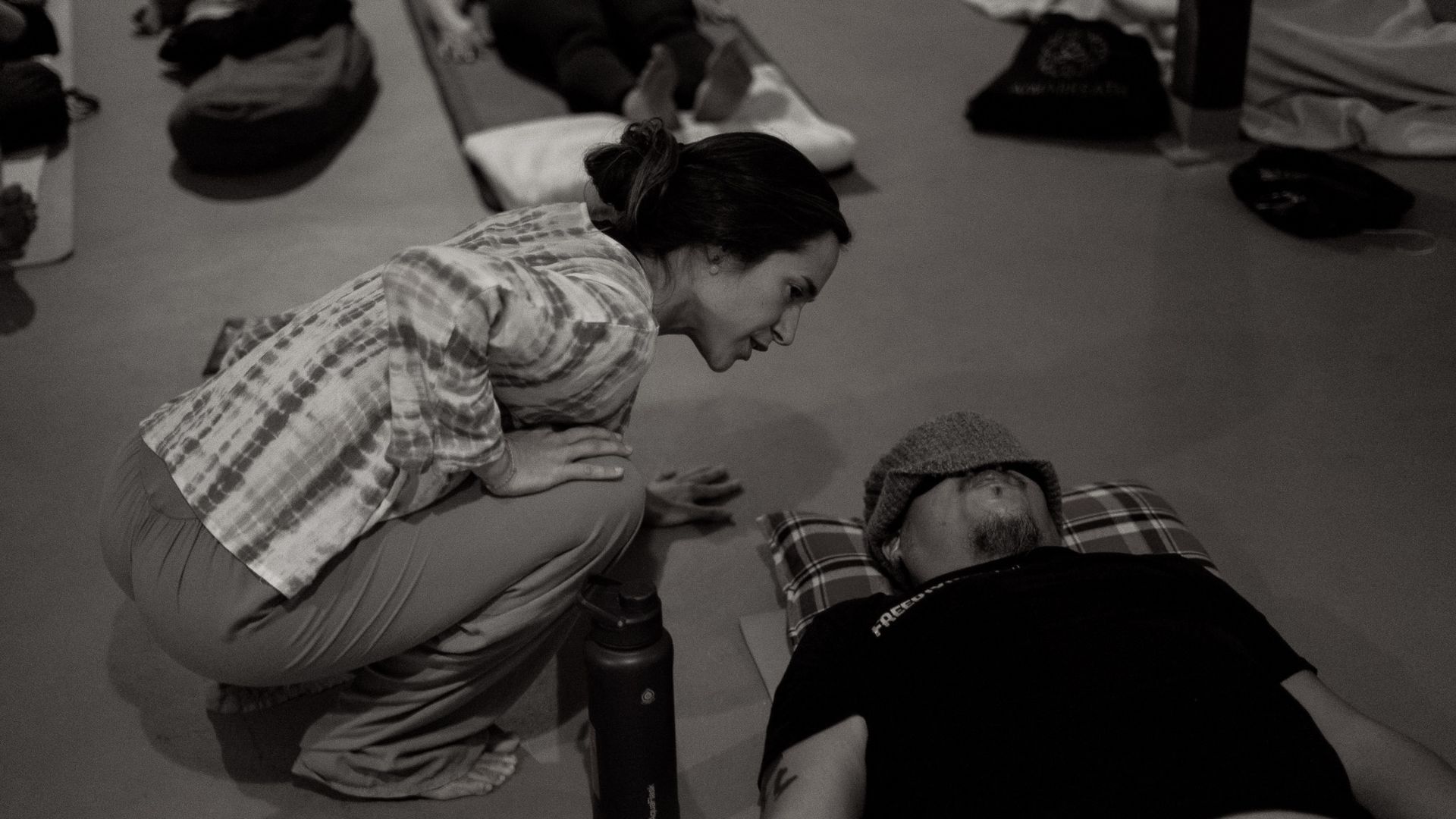


What carbon dioxide really does for your physical and mental health Everyone learns the same thing about carbon dioxide: it's the waste gas. Oxygen good, CO₂ bad — the stuff you breathe out and want to get rid of. And there's a second layer on top of that now, because CO₂ has become the headline villain of the climate conversation — so the reflex is to treat it as something harmful in any context. But the carbon dioxide warming the planet and the carbon dioxide in your bloodstream are two completely different questions — what's happening in the atmosphere tells you nothing about what CO₂ does inside your body. And inside your body, the "waste gas" story is one of the most widespread misunderstandings in all of human physiology. Once you correct it, a huge amount about breathing, stress, and health suddenly makes sense. Carbon dioxide isn't waste. It's one of the main regulators of how your body delivers oxygen, keeps blood flowing, holds its chemistry stable, and strongly influences how safe or threatened your nervous system feels. For most people, the problem isn't too much CO₂ — it's too little. Here are five things CO₂ actually does for you, plus the medical history almost nobody knows. First, why we got it so backwards The confusion comes from our obsession with oxygen. We assume breathing is about getting more oxygen in — so more breathing, deeper breathing, must be better. It feels obvious. But here's the catch: under normal conditions, your blood is already about 97–99% saturated with oxygen. It's essentially full. You cannot meaningfully add more by breathing harder — there's no room. So the idea that big, heavy breathing floods you with extra oxygen is simply wrong. The gas that actually changes when you alter your breathing is carbon dioxide. That's the lever. And when you understand what that lever does, the whole picture flips. Benefit 1: CO₂ is what delivers oxygen to your cells This is the big one, and it's the most counterintuitive fact in breathing physiology. Oxygen doesn't travel freely in your blood — it rides on haemoglobin, the protein in your red blood cells. And haemoglobin only releases that oxygen into your tissues when the right amount of carbon dioxide is present. This is called the Bohr effect. Where your cells are working hard and producing lots of CO₂, haemoglobin loosens its grip and hands over the oxygen. Where CO₂ is low, it holds on tight. Follow that through and you get the twist: if you over-breathe and blow off too much CO₂, your blood is still fully saturated with oxygen — but that oxygen stays stuck to the haemoglobin and doesn't get released where it's needed. You can have plenty of oxygen in your blood and still starve your tissues of it. More breathing, less delivery. CO₂ is the key that unlocks the oxygen — without enough of it, the oxygen goes nowhere. Benefit 2: CO₂ keeps your blood vessels open Carbon dioxide is a vasodilator — it relaxes and widens your blood vessels, which improves circulation. This is especially true in the brain. When you over-breathe and CO₂ drops, the opposite happens: blood vessels constrict, and blood flow to the brain falls. That reduced blood flow is what can leave people feeling lightheaded or dizzy when they hyperventilate. It's not lack of oxygen; it's low CO₂ narrowing the pipes. (If you've read my guide to breathwork, this is the exact mechanism the deep, activating styles use on purpose — driving CO₂ down to quiet the thinking brain and let emotion surface. Same physiology, opposite intent. Here we're talking about it happening by accident, all day, in people who chronically over-breathe.) Benefit 3: CO₂ helps keep your airways open CO₂ relaxes smooth muscle — including the smooth muscle lining your airways. Adequate CO₂ helps keep those airways open and relaxed. Drop it through over-breathing and the airways tighten. This is part of a genuinely strange loop: chronic over-breathers often feel more short of breath, not less, because breathing too much is tightening their airways. So they breathe even harder, and it gets worse. Learning to breathe less — lighter, slower, through the nose — is often what actually relieves the air hunger. This is exactly why breathing methods that deliberately slow the breath and reduce its volume, like Buteyko and the Oxygen Advantage, are used to help manage asthma: less breathing, not more, is often the fix. It sounds backwards until you know what CO₂ is doing. Benefit 4: CO₂ is what tells you to breathe Here's something most people have exactly backwards: the urge to breathe is not triggered by a lack of oxygen. It's triggered by rising carbon dioxide. Your brainstem constantly monitors CO₂, and when it climbs past a certain point, it fires the signal — that building discomfort, the "I need to breathe now" feeling. This is a safety system, and it's a good one. But it also means your urge to breathe is really a measure of your tolerance to CO₂, not your actual oxygen level. This is territory I know intimately as a freediver. When you hold your breath, the urge to breathe and those involuntary contractions arrive from CO₂ building up — long before you're actually low on oxygen. Training freediving is, in large part, training a calmer relationship with that CO₂ signal: learning that the urge is information, not an emergency. (It's also exactly why hyperventilating before a breath-hold is dangerous — you trick the alarm into staying quiet without adding meaningful oxygen, which is how people black out underwater. The CO₂ alarm is there to protect you.) Benefit 5: CO₂ and a calmer nervous system There's a well-documented link between carbon dioxide and anxiety — and it runs the opposite way to what you'd expect. When you're anxious, you tend to breathe faster and shallower, which drops your CO₂. Low CO₂ produces a specific set of physical symptoms: tingling in the hands and face, dizziness, and a racing heart. The problem is that those symptoms feel like anxiety — so they feed the fear, which drives more over-breathing, which drops CO₂ further. A self-reinforcing loop, and it's a big part of what's happening in a panic attack. This one is personal for me. Before I found freediving, I suffered from panic attacks. Since I started training — and, with it, slowly building my tolerance to CO₂ — I haven't had a single one. I can't prove to you that the CO₂ training is the reason; I changed a lot in my life around the same time, and I'm one person, not a study. But it fits what the research shows: sensitivity to CO₂ is closely associated with panic, some people's alarm systems are simply more reactive to it, and building a healthier tolerance appears to loosen that loop. My own experience lines up with the science, for whatever that's worth. I want to be careful here: this isn't a claim that breathing exercises cure anxiety, and if you're dealing with panic attacks, please don't read it as medical advice. But the connection between how you breathe, your CO₂ level, and how safe your nervous system feels is real, physiological, and worth taking seriously. CO₂ in medicine: a forgotten history, and a modern reality If all of this sounds fringe, it's worth knowing that medicine has taken carbon dioxide seriously for a very long time — and in some ways forgot it. By 1905, a New York physician named Achilles Rose had written an entire book, Carbonic Acid in Medicine, documenting CO₂ treatments, and European doctors were debating the effects of carbonated baths at medical congresses. A lot of that early work was empirical and never tested to modern standards, so it fell out of fashion. But the core observation — that CO₂ dilates blood vessels and improves circulation — was correct, and it survives today in CO₂ balneotherapy (carbonated mineral baths still used for circulation in Germany, Japan, and central Europe) and in carboxytherapy , a modern treatment using CO₂ for circulation and skin, where the evidence is still emerging. And far from being forgotten, CO₂ is woven through modern medicine in ways most people never realise: Keyhole surgery runs on it. The gas surgeons use to gently inflate the abdomen during laparoscopic surgery is carbon dioxide — chosen precisely because the body absorbs and clears it so safely. It's a vital sign. Anaesthetists and intensive-care doctors monitor exhaled CO₂ (capnography) as one of the most important signals of whether a patient is breathing properly. It's standard of care. Sometimes doctors deliberately let it run high. In certain ventilated patients, physicians allow CO₂ to rise above normal — "permissive hypercapnia" — because it lets them ventilate the lungs more gently and protect them. A real, evidence-based case of more CO₂ being the better option. Not a waste product. A tool. The honest caveat: better up to a point None of this means "CO₂ is good, so breathe as little as possible forever." Too much carbon dioxide is a genuine problem — it makes the blood too acidic and, at high enough levels, becomes dangerous. This is a sweet spot, not a one-way street. The reason there's a sweet spot at all comes down to pH. Carbon dioxide is the body's primary fast-acting lever for keeping blood acidity inside a very narrow safe band — too little CO₂ tips you toward alkaline, too much toward acidic, and your body works constantly to hold the balance. That's why it guards CO₂ so carefully, and why both extremes cause trouble. So why do I keep saying "more is often better"? Because in modern life, most people sit chronically on the low side. Stress, mouth-breathing, poor posture, and simple habit push us toward over-breathing, which keeps CO₂ slightly below where it should be. For the average person, "more CO₂" doesn't mean pushing above normal — it means climbing back up to normal. And that's exactly the balance doctors manage deliberately in a hospital. The goal is the right amount, and most of us are running short. How to raise your CO₂ tolerance The good news is that CO₂ tolerance is trainable. In broad strokes, it comes down to breathing less and breathing better: nasal breathing instead of mouth breathing, lighter and slower breathing through the day, and specific practices that gently build your body's comfort with rising CO₂. Two established bodies of work are built around exactly this — Buteyko and the Oxygen Advantage . And, as I've written elsewhere, freediving training is one of the most complete forms of CO₂-tolerance work there is. I won't lay out protocols here, because this kind of training is best done with proper guidance rather than from a paragraph on the internet — but the direction is simple: less air, more often, until it becomes your default. Where this fits with breathwork Once you understand carbon dioxide, breathwork stops being mysterious. Every breathing practice on earth is really just doing one of three things with CO₂: Calming practices let CO₂ rise gently back toward normal — which is part of why slow breathing feels settling. Activating practices drive CO₂ down deliberately, to shift your state and, at the deep end, unlock emotional release. Functional practices retrain your baseline tolerance to CO₂, so your everyday breathing improves for good. That's the whole map. If you want it in full, I've written a simple guide to the three families of breathwork, and a deeper guide to conscious connected breathwork — the practice I focus on most. But it all comes back to this one misunderstood gas. Get CO₂ right, and you get breathing right. Thinking of joining a session? If any of this has you curious, the easiest way to stay in the loop is my WhatsApp group. That's where I post updates on group sessions, online sessions, and retreats — and where new articles land first. Join the WhatsApp group
Confused about breathwork? A simple, honest guide to the three types — calming, activating, and functional — and how to choose the one that fits you.

This is a subtitle for your new post